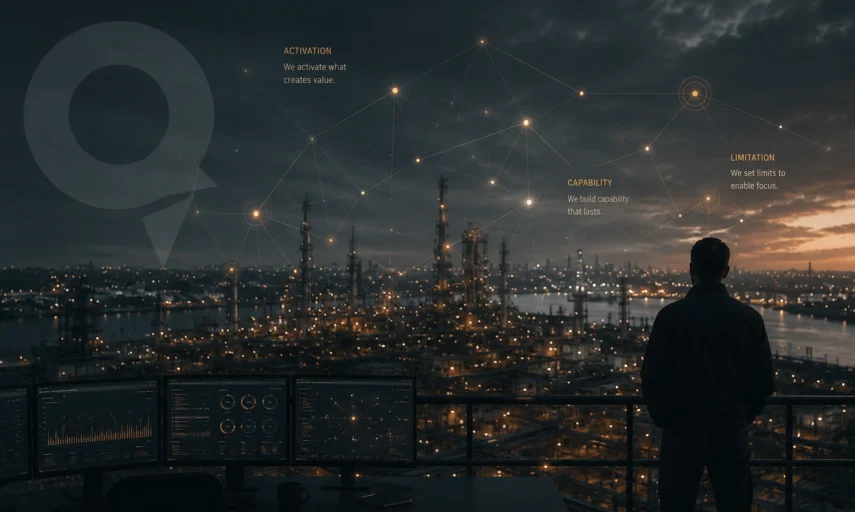
Why organizations often become heavier rather than more capable despite more data, more AI, and more governance
Today, many companies are investing heavily in digitalization, governance, AI, reporting, transparency, knowledge management, and increasingly sophisticated control and steering systems.
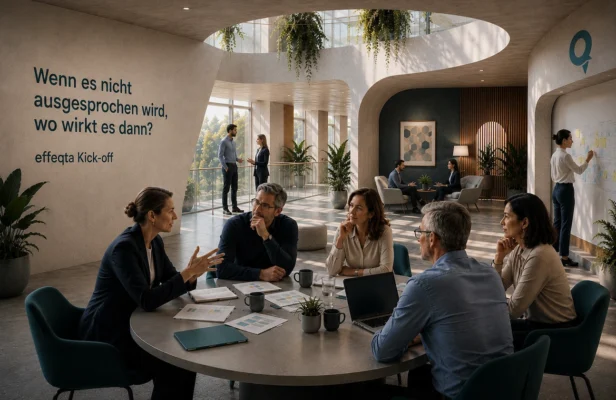
Yet across many projects and organizations, a growing perception is emerging: systems appear to become more intelligent — while people do not necessarily become more capable of working effectively.
Decisions take longer. Communication becomes more cautious. The number of meetings, reports, and coordination layers increases — clarity often does not. Reflection increases — decision capability not necessarily at the same pace. Greater visibility does not automatically create better collaboration.
Why?
At effeqta, we do not primarily view organizations as technical control systems, but as complex relational environments operating under conditions of limited human processing capacity. That fundamentally changes the perspective.
The underestimated risk of complex systems
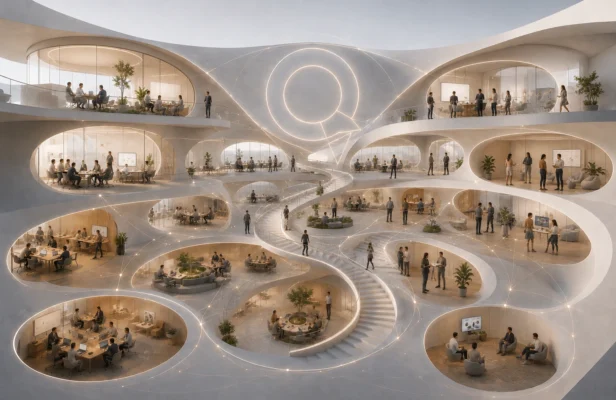
Across many modern organizational, governance and AI architectures, we increasingly observe dynamics of permanent activation, rising analysis and coordination density, reflexive overload, growing semantic complexity and increasing integration pressure. At the same time, a growing distance often emerges between model logic and actual organizational working reality.
The more capable systems become, the stronger the temptation often becomes to make everything increasingly visible, integrable, measurable, reconstructable, or controllable. But complex organizations do not function like linear machines.
People work within complex industrial project and supply chain environments under uncertainty, across technical, organizational, and regulatory requirements, through international interfaces, and under constant schedule, risk, and decision pressure. At the same time, they operate within relationships, conflicts, and situational dynamics — with limited attention, implicit knowledge, emotions, and human perception.
Especially in complex industrial, energy, and large-scale engineering projects, one pattern becomes increasingly visible: more governance does not automatically create more orientation. More reporting does not automatically create more clarity. More control does not automatically create greater operational capability. Learn how we support complex projects
Systems often become more intelligent — projects do not automatically become more workable as a result. And not everything can or should be meaningfully modeled, dashboarded, analyzed, or automated.
Reality remains larger than any model
Models matter. Governance matters. AI can provide enormous support.
But organizations gradually lose their ability to operate effectively when systems become more important than reality, when semantic coherence becomes more important than collaboration, when reporting becomes more important than actual decision capability, or when continuous activation becomes more important than organizational sustainability.
This is why we do not focus solely on project management, project controls, integrated scheduling, governance, reporting and decision structures, AI support, or knowledge architecture. One of effeqta’s core principles is:
“Reality takes precedence over model coherence”
— an effeqta prinziple
Equally important, in our view, are conscious limitation, non-intervention, recovery, activation management, human presence, and the ability to avoid organizational totalization.
Because long-term capability does not emerge from more control alone — but from creating workable conditions within real complexity.
Why limitation is becoming a core capability
Today, the primary challenge for many organizations is no longer a lack of information. Increasingly, the challenge is avoiding permanent states of activation, not forcing every tension into immediate integration, not translating every form of visibility directly into governance, not reflexively overreacting to every escalation, and not activating every possible AI capability continuously.
From our perspective, sustainable capability does not emerge through maximum integration — but through responsible limitation. This applies not only to systems, but also to language, governance, AI, analysis, reflection, reporting, and organizational activation intensity.
Under conditions of high complexity, one question becomes increasingly important: not every visible tension requires immediate activation.
AI is changing organizations more deeply than many realize
The real transformation driven by AI is likely not automation alone. AI is changing perception, meaning production, organizational speed, activation dynamics, decision architectures, and ultimately the relationship between humans, systems, and reality.
In this sense, AI does not merely change processes — it increasingly changes the conditions of organizational attention itself.
Especially within highly integrated industrial, energy, and infrastructure environments, this can significantly affect decision capability, coordination, responsibility dynamics, and organizational resilience. This is precisely why the following question becomes critical: how do projects remain workable under conditions of permanent digital activation?
In the coming years, this question may become more important than automation capability itself.
Our perspective
At effeqta, we therefore work toward a systemic understanding of organizational capability under complexity. Not with the goal of fully controlling organizations, modeling people, or technologically replacing reality. But with the question: how can projects remain capable of action, learning, and human alignment under conditions of growing complexity, AI support, and permanent change?
We believe:
The future does not belong to the systems with the highest level of activation. It belongs to organizations that understand when activation creates value — and when limitation becomes the more sustainable organizational capability. Organizations today do not simply need more systems. They need better conditions that allow people to remain capable of working under complexity.