How we understand, shape, and continuously develop quality
In many projects, quality is primarily associated with standards, auditability, control or technical precision. These aspects matter — but in demanding project environments, they are not sufficient on their own.
Large industrial, infrastructure and transformation projects evolve under time pressure, competing interests and high organizational complexity. What matters is not only technical quality, but a project’s ability to remain oriented, coordinated and capable of action even under difficult conditions. effeqta therefore does not understand quality as a static condition, the absence of errors or mere control. For us, quality becomes visible through:
- orientation in dynamic situations
- effective collaboration
- transparent and comprehensible decision-making
- early visibility of critical developments
- responsible handling of risks
- and stable, resilient project structures
Our ambition is the highest level of quality and client satisfaction — not as a marketing promise, but as a daily responsibility toward people, projects and organizations.

Operational excellence and real project practice
effeqta combines systemic understanding with strong operational project expertise.
For us, quality is reflected in robust structures, understandable information, transparent communication and professional execution in day-to-day project delivery. Our work should not only be convincing in theory — it must function under real project conditions.
Throughout our project experience, we have repeatedly seen that many later problems are already embedded in the early stages of a project. In particular, the project setup, the beginning of new project phases and the introduction of new tools, processes or forms of collaboration often shape the later stability, quality and capability of a project far more significantly than initially visible.
For this reason, we place great importance on careful preparation, forward-looking planning and the deliberate design of structures, responsibilities, communication and decision-making pathways.
For us, quality also means approaching projects and the concerns of our partners with genuine attention and care — rather than prematurely assuming that similar experiences automatically lead to the same solutions or conclusions. Especially in complex projects, many problems emerge where differences, tensions or contextual conditions are simplified or underestimated too early.
From our experience, particularly in early project phases, active listening, clarity, motivation and strong communication are often more important than short-term speed. Many project problems do not arise from a lack of activity, but from accelerating too early without sufficient shared orientation and preparation.
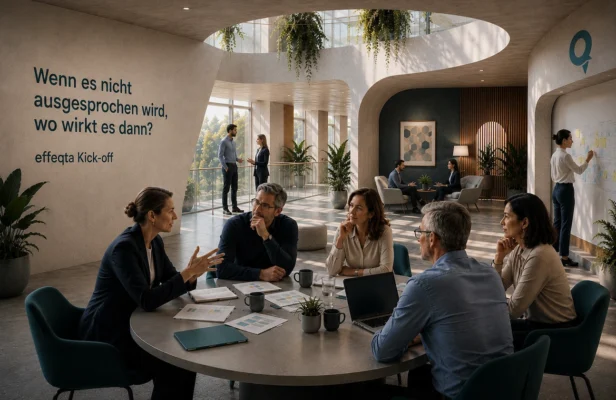
Quality also emerges between people
Projects are not built from processes and numbers alone.
They emerge through communication, collaboration, responsibility and the way uncertainty is handled. For this reason, we also consider the following questions to be part of quality:
- Are information and intentions truly understood?
- Can decisions be made in time?
- Does collaboration work across disciplines and interfaces?
- Do problems become visible early — or are they hidden?
- Does the environment foster trust or defensive behavior?
- How are influence, responsibility and conflict handled?
- Do people remain capable of action under pressure?
High project quality emerges where operational excellence and organizational understanding work together.
Orientation instead of artificial simplification
Complex projects cannot be fully controlled. But they can be understood more clearly.
effeqta therefore develops structures and perspectives that make projects more understandable, navigable and manageable — for example through:
- systemic project analysis
- integrated project structures
- transparent information and decision-making frameworks
- early warning mechanisms
- resonance and reflection formats
- project clarification workshops
- and modern forms of collaboration, learning and decision support
Our goal is not to artificially simplify reality. Our goal is to strengthen orientation and collective capability for action.
Transparency and responsible collaboration
effeqta places strong emphasis on transparent, realistic and sustainably viable collaboration.
This also includes openly and transparently addressing responsibilities, influence, risks, uncertainties and mutual expectations — both professionally and contractually. Project outcomes and developments always emerge from the interaction of many stakeholders, decisions and contextual conditions.
For us, this openness is not a form of distancing ourselves from responsibility, but part of professional, responsible and trustworthy collaboration. Not every development can be fully controlled or guaranteed by individual project partners. For this reason, we aim to ensure that responsibility remains as closely aligned as possible with actual decision-making authority, influence and capability for action. Our goal is not the transfer of responsibility, but clear and realistic forms of collaborative project work. Essential elements include:
- early identification of risks
- open and transparent communication of critical developments
- clear accountability and decision structures
- appropriate risk mitigation and protection measures
- and the continuous support of critical project dynamics
effeqta takes responsibility for the quality, diligence and professional integrity of the services, analyses, decision foundations and support formats that we jointly develop, facilitate and anchor within projects together with our partners.
Quality also means safety, sustainability and reliability
effeqta does not view quality in isolation. Particularly in industrial and infrastructure projects, quality also includes HSE requirements, data protection and information security, transparent governance, regulatory and contractual compliance, as well as adherence to relevant standards, frameworks and organizational requirements.
We align our work with established project management and quality standards, as well as relevant European, national and industry-specific frameworks. This includes, among others:
- standards and frameworks of the International Organization for Standardization (ISO)
- competencies and approaches associated with the Project Management Institute (PMI) and the International Project Management Association (IPMA)
- agile and hybrid delivery approaches, including Scrum, Kanban and adaptive project management practices
- European, national and industry-specific requirements regarding data protection, security and compliance
- regulatory approvals, authority requirements and release processes
- as well as project-specific regulatory and organizational conditions
We do not view standards as mere formalities, but as part of responsible and resilient project delivery.
For us, sustainability is reflected not only in the responsible use of resources, but also in stable collaboration, resilient decisions and project structures that remain viable over time. Especially in the field of HSE, we see quality, safety, responsibility and sustainability as deeply interconnected.
Quality, governance and the responsible use of AI
effeqta does not view digitalization and artificial intelligence merely as instruments of automation.
We regard AI as a supportive tool embedded within human and organizational contexts. Our goal is not to outsource responsibility to systems, but to strengthen orientation, access to knowledge and organizational learning capabilities in meaningful ways.
To support this, effeqta develops organizational foundations that enable long-term traceability and stable knowledge structures. Key elements include:
- clear governance structures
- defined responsibilities
- transparent documentation logic
- a structured organizational memory
- comprehensible knowledge architectures
- and deliberate rules regarding the use and limitations of AI systems
We do not understand knowledge as a loose collection of information, but as part of an organization’s capacity to learn and make decisions. Our organizational memory therefore serves the long-term preservation of orientation, context, traceability, organizational learning and semantic stability within our knowledge and decision structures.
Quality through collective development
Sustainable quality emerges where organizations remain capable of learning and engage transparently and responsibly with the realities of their projects.
effeqta continuously reflects on and challenges its own ways of working, consciously integrating feedback into ongoing development. This includes feedback formats, qualitative surveys, project reflections, lessons-learned approaches, as well as resonance and dialogue formats. At the center of our work lies the question of how people and organizations can learn from project experience and continuously improve the way they collaborate.
effeqta does not view project management competence as something developed in isolation within a single company. We see effective project management as a collective development effort between practice, academia and professional communities.
For this reason, we actively collaborate with external institutions, professional associations, universities and partners from industry and research — including within the environment of the Project Management Institute.
Our engagement includes knowledge exchange and professional networking, methodological development, research and innovation initiatives, mentoring, professional presentations and dialogue formats, as well as active participation in professional project management communities. For effeqta, quality means shaping projects in ways that enable people and organizations to collaborate effectively even under uncertainty, pressure and complexity.