What complex projects have taught us about early warnings, interdependencies, and effective Project Controls
Of course, the critical path is a property of the schedule. But the development that eventually makes an activity or milestone critical often begins somewhere else entirely.
We have spent many years working with schedules, costs, risks, progress, changes, and reporting. And one pattern has emerged time and again: by the time a problem becomes clearly visible in Project Controls, its story has often been unfolding for quite some time.
A missed milestone rarely begins on the day the schedule turns red. A cost overrun does not necessarily originate where it first appears in the cost report. And a risk does not begin to exist only when it enters the risk register.
That is where the problem becomes visible. Its origins often lie earlier – and somewhere else in the project.
When the visible problem is not the cause
In one project, the construction team discovered that material required for installation was missing from site. At first, it looked like a late delivery.
Then came the realization: the material had never been ordered. Somewhere between scope, engineering, material definition, procurement, and construction, information had not been passed on, responsibility had not been clearly assigned, or a necessary action had not been followed through. By the time the missing material was noticed on site, the underlying development was already months old.
Situations like this changed the way we look at Project Controls. They demonstrate that the place where a deviation becomes visible is not necessarily the place where it originated.
When metrics tell different stories
Consider physical progress. The schedule continues to show the planned completion date. At the same time, actual progress is significantly behind plan.
So which one is right? Possibly both. There may be a credible recovery strategy, additional resources, or realistic opportunities to perform activities in parallel. If so, however, the expected impact of those measures should also be demonstrable and traceable.
But if the progress gap continues to widen month after month while the completion date remains unchanged, the discrepancy between those two statements becomes important information in its own right. At that point, the individual metric is no longer the only thing that matters. What becomes critical is whether the different signals from the project still tell a coherent story.
This is precisely why we see progress measurement as more than another curve in the monthly report. It can become an important plausibility check between actual performance, schedule development, and cost.
When a worse metric can lead to a better decision
Costs cannot be considered meaningfully in isolation either.
A project is under cash-flow pressure. At the same time, critical equipment could be ordered earlier, reducing the risk of future delivery delays and schedule impact.
Placing the order worsens cash flow today. Does that make it the wrong decision? Not necessarily.
From the perspective of the overall project, it may be economically sound to consciously accept a weaker metric today in order to avoid a significantly greater risk tomorrow.
The relevant question, therefore, is not simply: is the cash flow good or bad? It is: what effect will our decision have on the project as a whole?
Project Controls should not make that decision in advance. Its role, however, is to make the relevant interdependencies visible so that the decision can be made consciously and with a clear understanding of its implications.
When a risk is not yet called a risk
The risk register may contain a general schedule risk.
At the same time, an important technical decision remains unresolved for an unusually long period. A supplier repeatedly delivers late. Progress begins to slip. Several small changes affect the same area. None of these signals has to be critical on its own. Their combination might be.
Months later, the resulting delay may be easy to identify. The same applies to additional cost or a commercially significant change. The more difficult task begins earlier: at the point where individual observations still appear insignificant but gradually begin to form a pattern.
For us, risk management therefore means more than identifying, assessing, and tracking known risks. It also means recognizing developments before we can clearly label them as risks at all.
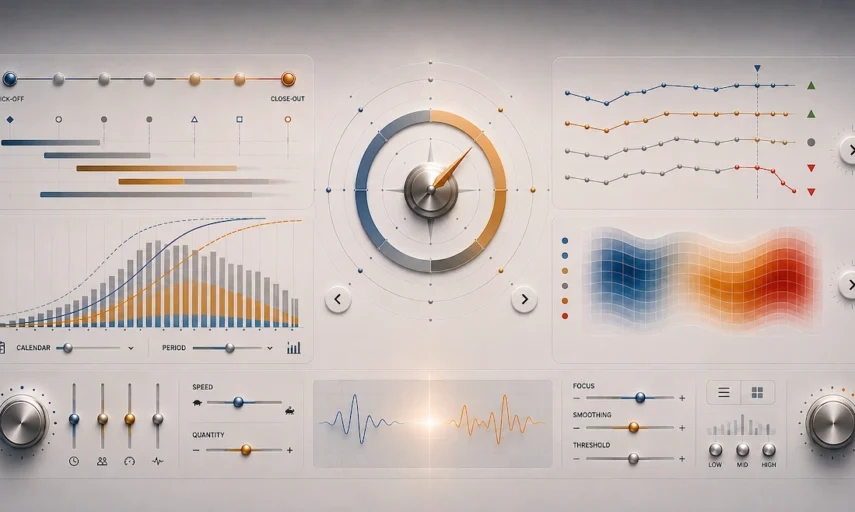
A dashboard is not yet a cockpit
Today, we can visualize enormous volumes of project data. But more data does not automatically mean better control.
A cockpit does not display everything that is technically known about an aircraft. It displays the information required to understand its condition, recognize change, and act in time.
The same principle applies to projects. The objective is not to display as many KPIs as possible. The objective is to make visible the information that matters for responsibility and decision-making – while preserving the relationships between those pieces of information.
And reporting does not stop at the boundaries of our own organization. A remark in a supplier or construction report may become relevant months later to scheduling, change management, or claims.
If such an observation is documented but never recognized, interpreted, or connected with other developments, it remains just information. It has not yet become part of project control.
The visible problem is rarely the beginning
A missing purchase order. A growing progress gap. A cash-flow decision. An emerging risk. An overlooked report.
At first glance, these are very different situations. But they share a fundamental structure:
PatternBetween the origin of a development and its later visible impact lie information, decisions, dependencies, and change
This is where much of the complexity of projects emerges. The critical path of such a development may therefore have begun long before its consequences become visible as critical in the schedule.
Do not just measure states. Recognize movement
Project Controls has become increasingly sophisticated over the past decades.
We have professional scheduling, cost control, risk and change management, progress measurement systems, digital dashboards, and ever-growing volumes of data. We need these instruments. But a project changes continuously – not just once a month when the next report is produced.
That is why, alongside the state of the project at a reporting cut-off date, we are particularly interested in the movement between those points in time. What has changed? Which gap is widening? Which assumption may no longer hold? Where are different pieces of information beginning to contradict one another? Where are several small developments reinforcing each other? And where is a pattern beginning to emerge?
These changes, differences, and connections often contain the project’s early warnings. The sooner we recognize them, the more room we retain to act.
Project control does not mean controlling every outcome
Complex projects cannot be fully predicted or controlled.
Even the best Project Controls system cannot guarantee a particular outcome. But we can influence the conditions under which good decisions and effective action become possible.
Is relevant information available in time? Are different perspectives connected? Are changes visible before they develop into critical deviations? Can existing assumptions be challenged? Do we recognize developments early enough to still have alternatives?
This also changes our understanding of control. We do not simply steer towards a desired outcome. We also shape the conditions that make that outcome more likely.
Project controls must serve the project
At effeqta, we therefore do not see Project Controls as a collection of separate methods, systems, and metrics.
Scheduling, cost, risk, change, physical progress, and reporting provide different perspectives on the same project reality. Their real value for project control emerges when these perspectives are connected.
We support organizations in establishing Project Controls and scheduling systems. And we support projects when they begin to send contradictory signals, when forecasts no longer appear plausible, or when the available data no longer provides a clear basis for decision-making.
This is not about replacing proven methods. Nor is it about producing ever more data.
It is about recognizing earlier: what is changing right now? Which interdependencies are affected? What impact could emerge from this? And where can we still intervene effectively?
That is why we do not look only at states. We observe change and the patterns it creates.
This reveals something like the pulse of the project: not as another metric, but as a way of seeing movement, differences, interdependencies, and early signals between established Project Controls information.
Because often, it is not the individual piece of information that matters most. What matters is what happens between the information.